
Pulse Monitoring — Part 2
An optimization of the original system focused on higher data-gathering rates and reliable real-time transmission.
- Research
- Raspberry Pi
- ADC
- Real-time
Description
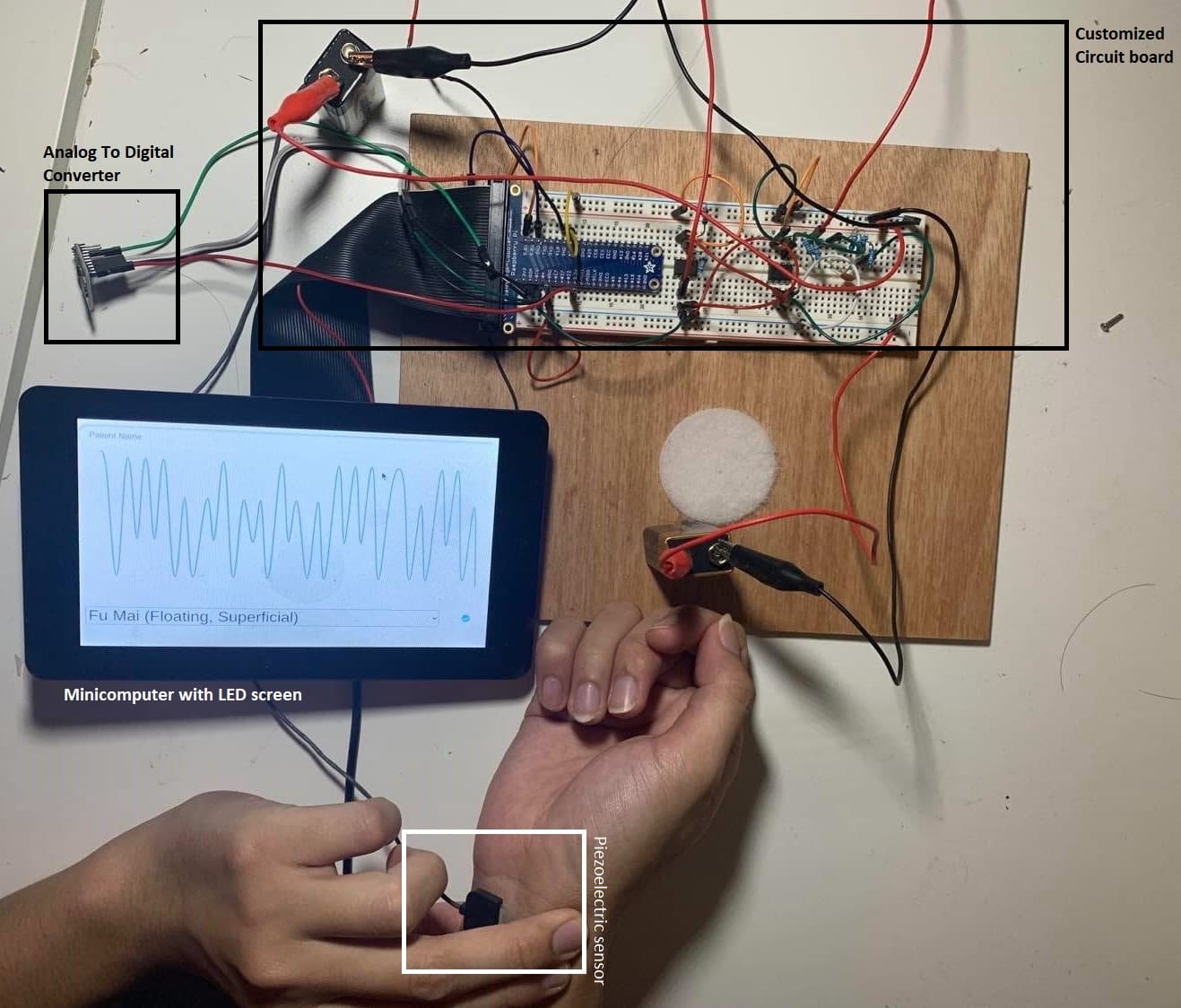
Continuing from the first part, we began optimizing the system. As discussed in our first paper, the BLE transmission experienced data loss that was crucial for diagnosis and reduced reliability. This part focused on improving the data-gathering rate and transmission for better real-time visualization.
Design details
We revised the system and replaced the Arduino microcontroller with a Raspberry Pi for more robust computation. That required adding an Analog-to-Digital Converter (ADC) between the circuit and the Pi's GPIO pins — previously handled by the Arduino's embedded ADC. We also simplified the software by removing the remote diagnosis layer (including the 3D-printed finger and the doctor/patient apps) and moved the frontend onto the Raspberry Pi, displayed on an LED screen. This reduced transmission time and improved the real-time experience.
Result
By the end of the project we had a working device and published our work at IEEE MIT URTC 2020, having pitched the idea in a Lightning Talk at IEEE MIT URTC 2019.